Someone must've invented time travel and messed up the history books[1] as, with the English fleet prevented from sailing by a contrary wind, the Armada has put ashore a force under Don Alonso to try and take Portsmouth from the rear. John, Lord Bawdesley has rounded up a scratch force and occupied a blocking position to save the fleet.
The armies faced off against each other, the Spanish convinced their greater military experience and expertise would triumph, and the English confident that pluck and patriotism would be enough to see off the Dons.

The armies were broadly similar:
The English Army:
4x Battles with pike, bill, musket, arquebus and bow
2x squadrons of demi-lance with lance
2x troops of border staves (light horse)
2x medium guns (dug-in behind earthworks)
The Spanish Army:
1x large, veteran Tercio with pike, sword & buckler, musket and arquebus
3x Tercios with pike, musket and arquebus
2x squadrons of cuirassier (mercenary)
2x troops of petronels (arquebus)
2x medium guns
The veteran Tercio should give the Spanish the edge, and they were clearly going to use it, aiming it at the English centre.

The English Battles facing them, while the equal of the non-veteran Tercios, were clearly up against it.

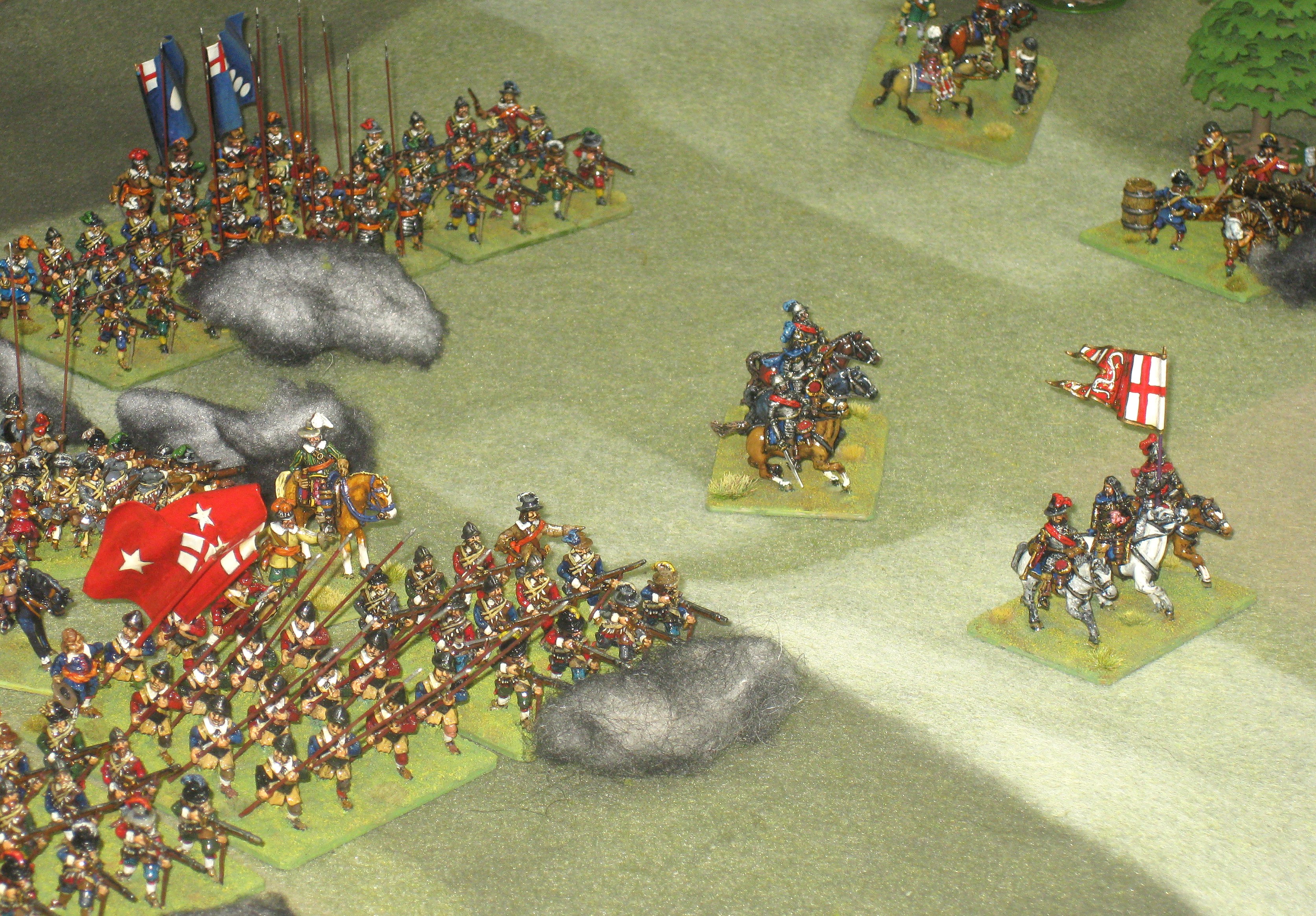
Both sides had deployed most of their horse at the eastern end of their lines: the English with both demi-lance squadrons and a troop of border horse; and the Spanish (shown below) with two troops of petronels and one of mercenary cuirassiers.

With deployment complete we rolled average dice to determine our generals' ratings. The English ended up with two level-3 generals and one level-2 ...
 |
| John, Lord Bawdesley the English C-in-C (level-3) |
.. the Spanish did slightly worse with only one level-3 and two level-1 generals.
 |
| Don Alonso the Spanish C-in-C (level-3) aghast at the quality of his subordinates! |
Both C-in-C's took command of the main body in the centre, leaving their subordinates to command the wings. And so, let the game begin.
Turn 1: and the English won the D6 roll-off for initiative, but chose to let the Spanish take the first activation[2]. The Spanish started quite conventionally, with their artillery bombarding the opposition, a move followed by the English.
After this, ineffective, preliminary bombardment the Spanish Tercios advanced at the run, first with their centre ...

... and then on their right towards Windmill Hill.

The English infantry contented themselves with advancing their foot to the forward slopes of the occupied hills. Then they launched both demi-lance units on their right flank in a charge at the Spanish horse who, unfortunately had not, as the English anticipated, advanced and the demi-lances' charge came up short.

To rub in their misfortune the Spanish petronel units reacted by firing at them but without effect.
Turn 2: the English won the initiative, and again ceded the first turn to the Spanish. The Spanish led off by activating a petronel unit to fire again at the demi-lances before they could charge again. But again, the firing dice did not live up to expectation.


The cavalry battle then petered out with nothing more of consequence occurring in this turn.
But elsewhere, the Spanish centre continued their rush to engage the English infantry as quickly as possible, the English only responding with some ineffective long-range archery.

The Spanish had left one Tercio behind on their left flank, by the wood at the top-left of the above image. This was intended as reserve cum flank guard until the intent of the English cavalry and rightmost Battle were clearer. They are also safe from artillery fire behind a small hill.
Turn 3: and the English, having won the initiative, chose to take the first activation. Their focus was on the cavalry fight on their right but this was a dice disaster with units failing activate (owing to wear taken) and suffering more wear from the Petronels' firing.

As ever the Spanish main effort was to get their Tercios into combat, the first to charge being the large, veteran Tercio. To their discomfort the English held them to a draw! The Spanish then invoked the 'Bad War' rule that allows another round of combat in the event of draw between pike-armed units, they also gain an advantage in a second round from their sword and buckler armed troops. The second round saw the English shamefully defeated and forced to retreat.

The next Spanish Tercio didn't need two chances, defeating their opponents in the first round. The English centre seemed to be falling apart with two battles in full retreat from the victorious Tercios.

On Windmill Hill, on the eastern flank, there was finally some good news for the English as their battle charged down the hill to defeat the Tercio on that flank, but not decisively.

An overview at the end of Turn 3 is shown below.

Turn 4: and the English with the initiative took the first activation, ordering their victorious Battle to try and finish off the defeated Tercio.


The cavalry fight remained indecisive, but the English moved their border stave troop towards their beleaguered centre, where the last two unengaged foot units were now closing on each other.

In the centre the victorious Tercios advanced at the run to get to grips with the defeated English Battles before they could reform and recover.

Turn 5: and the Spanish finally manage to win the initiative. They put it to work in the cavalry combat, but the petronel shooting proves indecisive. The English response sees a demi-lance squadron charge the petronels who evade leaving the demi-lances to collide with the cuirassiers in the Spanish second line. Both units are broken in this combat as they both fail 'break tests'[4] - the cuirassiers, unlike the demi-lances, have for some reason not been posed as routing in the photo below.

This saw the eastern flank considerably thinned out, prompting the English to move the border horse back to support the remaining demi-lance squadron (see top-left of photo below).

Beyond the cavalry fight the latest clash between Tercio and Battle had again gone decisively in favour of the invaders - the English can be seen retreating in the top-left of the image below.

Elsewhere in the centre the veteran Tercio stumbled and was defeated and forced to disengage by the rallied English Battle.

On the western flank the Tercio followed up the retreating English Battle.


Also seen in the above are the Spanish cuirassiers and border horse who skirmished ineffectively with each other throughout the battle, hence have been largely ignored in this report.
Turn 6: and the Spanish had the initiative which they put into immediate effect by rallying most of the wear from the veteran Tercio. The English had assumed the opposing English Battle was about to be charged by this Tercio so had given it 'Assault' orders that would allow it to counter-charge. This unfortunately meant the 'weary' English Battle was now committed to charge in against a nearly fresh veteran Tercio. The result was disaster as the Battle broke and fled the field.

The Spanish then charged right flank Tercio up Windmill Hill and broke the Battle there as well.

Although the other two Battles survived this turn, one even defeating the opposing Tercio, and the demi-lances finally managed to destroy a petronel troop ... ...

History had been turned on its head!
Notes:
[1.] Actually, this was just a throw down game using John's Spanish and English renaissance armies to allow him to try out the Liber Militum Tercios rules which he had not played before.
[2.] Activation of units alternates between the two side until all units with orders have been activated. All units are assigned a face-down order card at the beginning of the turn, these are one of the following: 'Run', 'Assault', 'Shoot', 'Ready' or 'Resist'.
[3.] If a unite receives more 'wear' (hits) than its 'stamina' level it must test to see if routs (removed from the table as lost).
[4.] Actually, the cuirassiers are a 'mercenary' unit and thus never take break tests as they automatically leave the field if their wear ever exceeds their 'stamina' level.